
Class placement shouldn’t take a week
Every year, the same problem. Hundreds of students need to go into classes. Gender balance. Reading levels spread evenly. Special needs hours shared fairly. Siblings together. Conflicts apart. Parent requests honoured where possible. You move one student and three constraints break. You get close enough, give up, and hope the staffroom doesn’t revolt.
Balanced Allocate places your entire cohort in seconds — and proves it’s fair.
Start Free Trial — 14 days free, no credit card.
32 students. 4 classes. 7 constraint types.
Greenfield Primary needs to form four Year 3 classes from 32 incoming students. The placement coordinator has to satisfy all of these simultaneously:
- Every class 40–60% female
- Reading levels (Advanced, Proficient, Basic, Below Basic) spread evenly across all classes
- No class carries more than 25 IEP hours
- Siblings in the same class
- Documented behavioural conflicts in separate classes
- Parent teacher requests honoured
- Even class sizes
The teachers have opinions. The parents have requests. The deputy principal has policy. One spreadsheet can’t hold all of it at once. The solver can.
How it works in practice
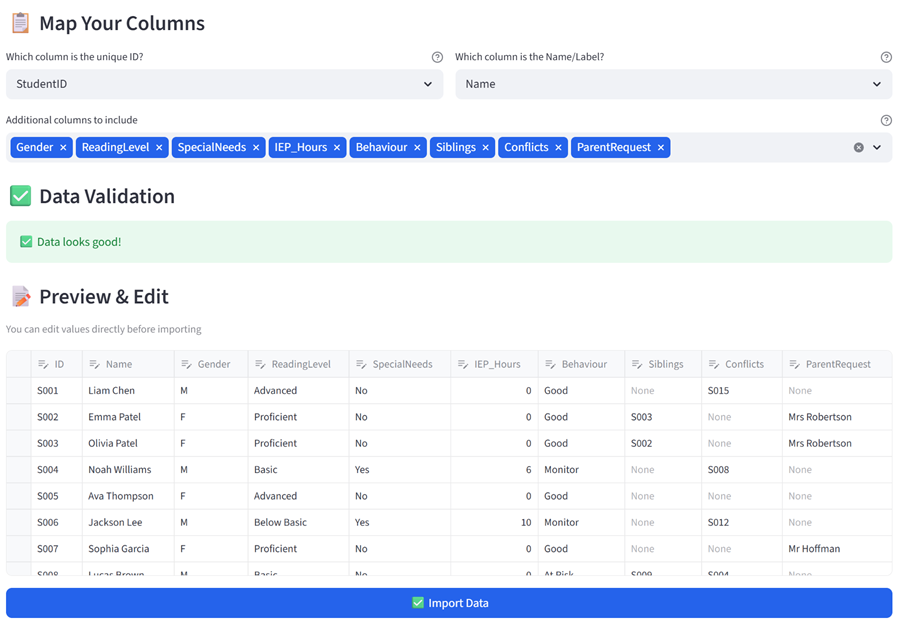
Step 1: Upload your student list
The same spreadsheet you already maintain. Student names, gender, reading level, IEP hours, sibling links, conflict flags, parent requests. CSV or Excel.
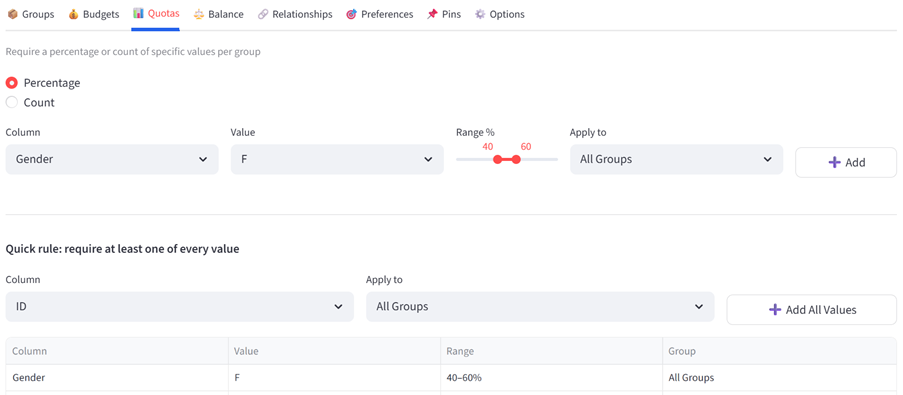
Step 2: Set your rules
Gender quota: 40–60% female in every class. Balance: reading levels spread evenly. Budget: max 25 IEP hours per class. Relationships: siblings together, conflicts apart. Pins: parent-requested students go to their requested teacher. Five minutes of clicking — no formulas, no code.
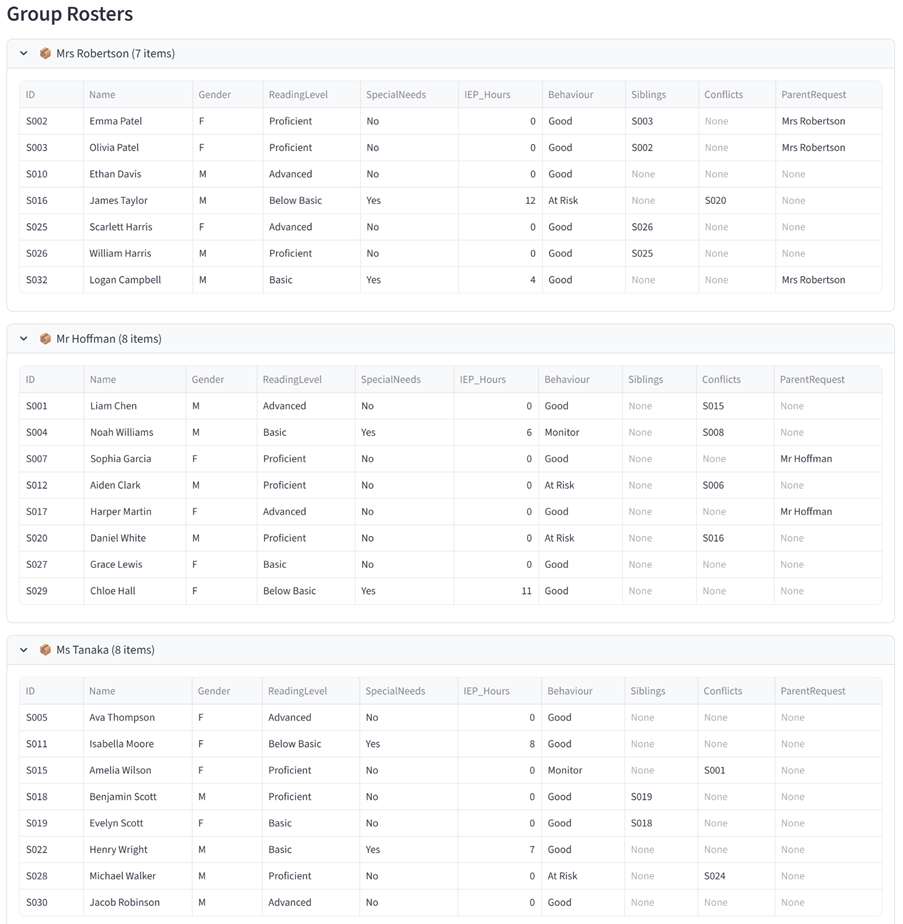
Step 3: Get your classes
Each class has 7–9 students. Gender is balanced. Reading levels are spread. No class exceeds 25 IEP hours. The Patel sisters are together. Liam and his conflict partner are in different classes. Parent-requested students are with their preferred teacher.
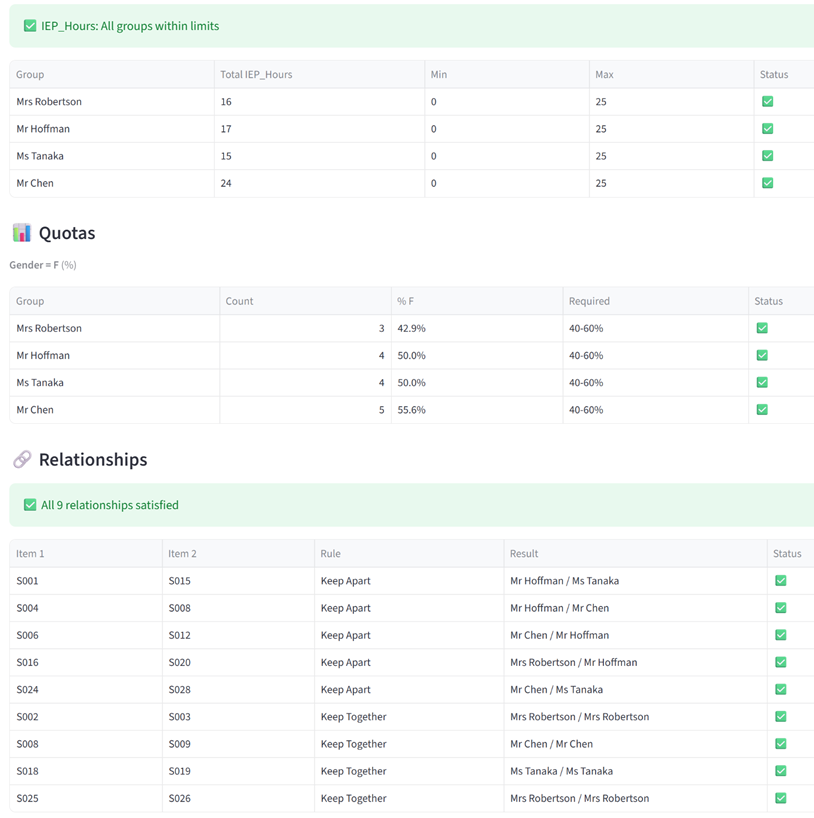
Step 4: Prove it’s fair
The Validation tab checks every rule and shows pass or fail. The Analytics tab lets you explore any column across classes — reading level distribution, gender split, special needs load. When the principal asks how placements were decided, hand them the PDF. Every constraint is documented.
The result
Without Balanced Allocate: three teachers, two days, one wall covered in sticky notes. Complaints in week two when parents compare class lists. No audit trail. “We did our best” is the only explanation.
With Balanced Allocate: one coordinator, every constraint documented. A full validation report showing exactly why each student is where they are. The placement is defensible because it’s provably fair.
Not just classroom placement
The same tool handles any allocation problem in education:
- Scholarship selection: Choose the best 12 recipients from 200 applicants while meeting Indigenous, regional, and gender equity quotas within a fixed budget
- Composite classes: Split 90 students across three multi-age classes balanced by year level, ability, and behaviour
- Camp or excursion groups: Form cabin groups with friends together, allergies spread, and gender balanced
- Elective blocks: Allocate 300 students to subject lines respecting preferences, class caps, and prerequisite requirements
- Next year’s placement: Save this year’s rules and reload them with a fresh student list — same policy, new cohort
Try it yourself
Download the Balanced Allocate User Guide with this, plus additional full examples, walkthroughs, constraints and dataset formats. The data used in this example is also available for download below.
Your data stays in your session. Nothing is stored.
Ready to stop placing students by hand?
Start Free Trial — 14 days free, no credit card.