
Selecting grant recipients shouldn’t be political
Thirty applicants. Twelve funded places. The selection panel has to pick the strongest candidates while meeting Indigenous targets, regional quotas, gender balance, field diversity, and a fixed stipend budget. Pure merit leaves equity gaps. Pure equity ignores merit. The panel argues for hours, compromises badly, and nobody can explain the final decision.
Balanced Allocate finds the highest-merit selection that satisfies every requirement — and documents exactly how.
Start Free Trial — 14 days free, no credit card.
30 applicants. 12 places. 11 constraints. One optimal answer.
The Department of Training administers 12 funded industry work placements each year. The selection must balance all of these at once:
- Maximise merit scores in the selected group
- At least 3 placements for Indigenous applicants
- At least 3 for regional applicants
- 40–60% female
- Every field of study represented (Engineering, Health, IT, Law, Business, Education)
- No single university takes more than 5 places
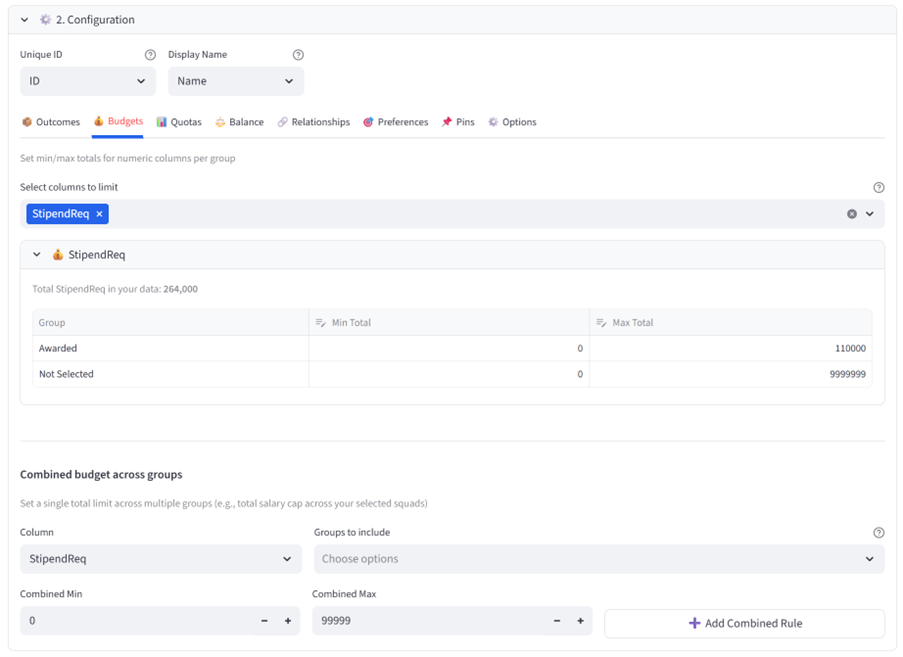
- Total stipend budget cannot exceed $110,000
- Indigenous and regional applicants receive $10,000 stipends; others receive $8,000
Some high-scoring applicants will miss out because selecting them would break a quota or blow the budget. The tool makes that trade-off transparently — not behind closed doors.
How it works in practice
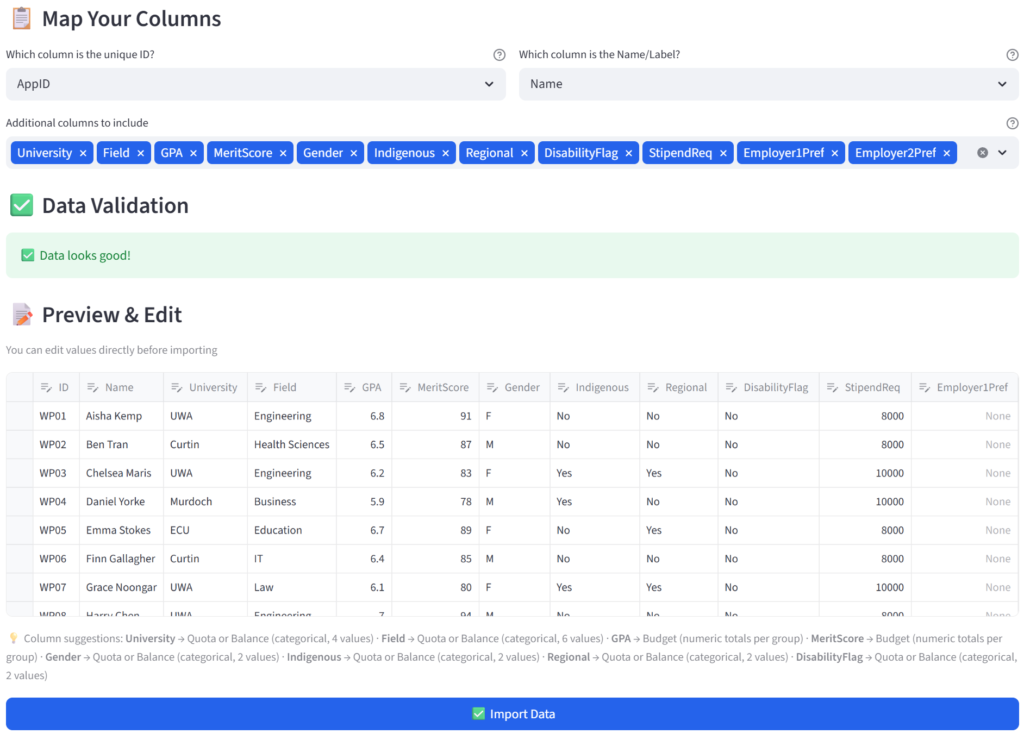
Step 1: Upload your applicant list
Your existing assessment spreadsheet. Applicant names, university, field, GPA, merit score, gender, Indigenous status, regional status, stipend requirement. CSV or Excel.
Step 2: Set your rules
Two groups: Awarded (exactly 12) and Not Selected (the rest). Maximise merit score in the Awarded group. Budget: total stipend max $110,000. Quotas: at least 3 Indigenous, at least 3 regional, 40–60% female, at least 1 from each field, max 5 from any university. Minutes to configure — the solver handles the combinatorics.
Step 3: Get your selection
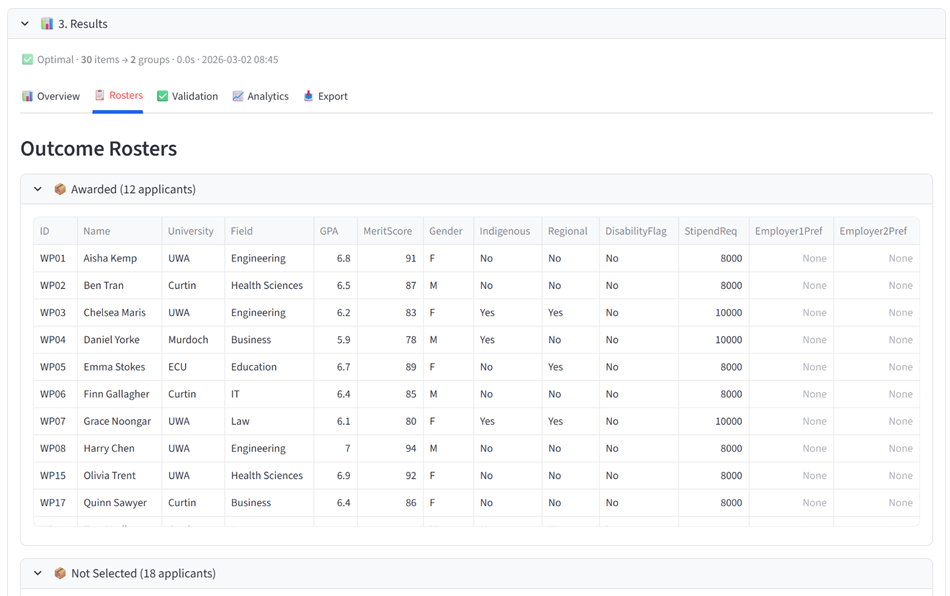
The 12 strongest applicants who satisfy every equity and budget constraint. Average merit score in the Awarded group is 85. The Not Selected group averages 68. The stipend total comes in at $108,000. All six fields are represented. No university dominates.
Step 4: Prove it’s defensible
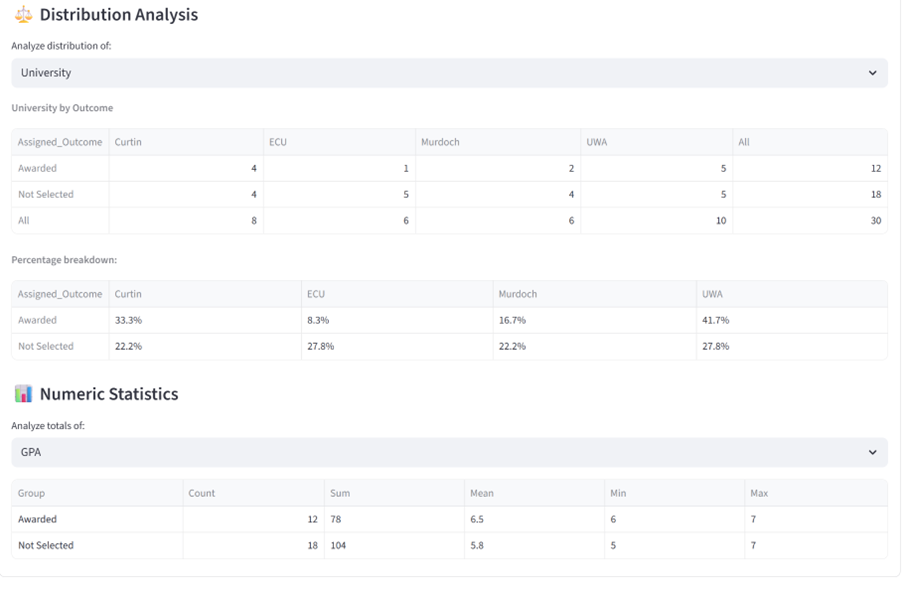
The Validation tab shows every constraint met. The Analytics tab shows merit score distributions, university spread, and field coverage across both groups. Export the Excel report with a full constraint audit trail. When the minister’s office asks how selections were made, the answer is a document — not a conversation.
The result
Without Balanced Allocate: a six-hour panel meeting, three rounds of revoting, a selection that satisfies most targets but quietly misses two. No audit trail beyond meeting minutes. An FOI request waiting to happen.
With Balanced Allocate: one analyst, minutes, a mathematically optimal selection with a full audit trail. Every quota met. Every dollar accounted for. Every trade-off documented.
Not just work placements
The same select/reject pattern works for any competitive allocation with constraints:
- Research grants: Select 40 funded projects from 500 applications while meeting discipline quotas, institutional caps, and a total budget ceiling
- Scholarship panels: Award bursaries maximising academic merit while meeting equity, regional, and socioeconomic targets
- Award shortlisting: Narrow 200 nominations to 10 finalists balanced by category, geography, and demographics
- Program admissions: Accept 60 students from 300 applicants into a competitive program with diversity and prerequisite requirements
- Procurement panels: Shortlist vendors under cost ceilings, risk scores, and category coverage requirements
Try it yourself
Download the Balanced Allocate User Guide with this, plus additional full examples, walkthroughs, constraints and dataset formats. The data used in this example is also available for download below.
Your data stays in your browser session. Nothing is stored on our servers.
Ready to stop making selection decisions in a meeting room?
Start Free Trial — 14 days free, no credit card.