
Vendor shortlisting shouldn’t be a spreadsheet argument
Forty-two vendors responded to the tender. You need to shortlist eight for the panel. Procurement policy requires geographic diversity, Indigenous supplier representation, category coverage, and a total cost envelope. The evaluation team scores them on capability, risk, and price — but the top eight on merit alone come from three cities and miss two categories entirely. So you start swapping vendors in and out, breaking one rule to fix another, until someone says “that’s close enough.”
Balanced Allocate finds the strongest compliant shortlist automatically — and shows exactly why each vendor made the cut.
Start Free Trial — 14 days free, no credit card.
42 vendors. 8 panel places. Policy, merit, and budget — simultaneously.
A state infrastructure agency is forming a supplier panel from 42 tender responses. The procurement team must satisfy all of these at once:
- Maximise combined capability scores in the selected panel
- Total estimated contract value cannot exceed $12M
- At least 2 Indigenous-owned businesses
- At least 1 vendor from each of 4 service categories (Civil, Electrical, Mechanical, Environmental)
- No more than 3 vendors from any single region
- At least 2 regional suppliers
- Risk-weighted score above a minimum threshold
- Panel size fixed at 8
Picking the top 8 on score alone violates three policies. Picking for compliance alone leaves the strongest vendors off the panel. The solver finds the intersection.
How it works in practice
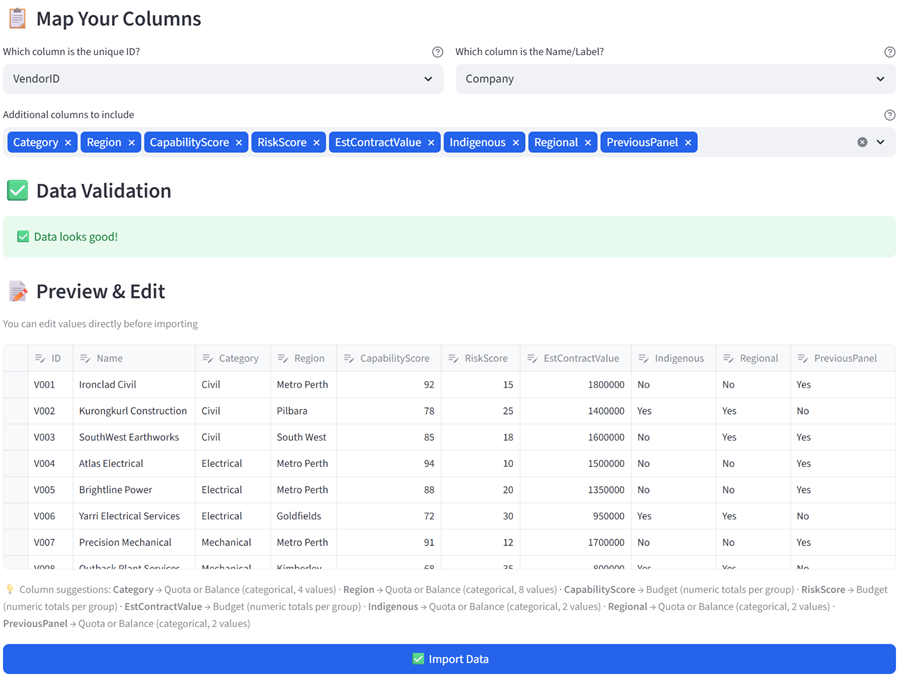
Step 1: Upload your evaluation register
The same scoring spreadsheet your evaluation team already produced. Vendor names, capability scores, risk ratings, estimated contract values, categories, regions, Indigenous status. CSV or Excel.
Step 2: Set your rules
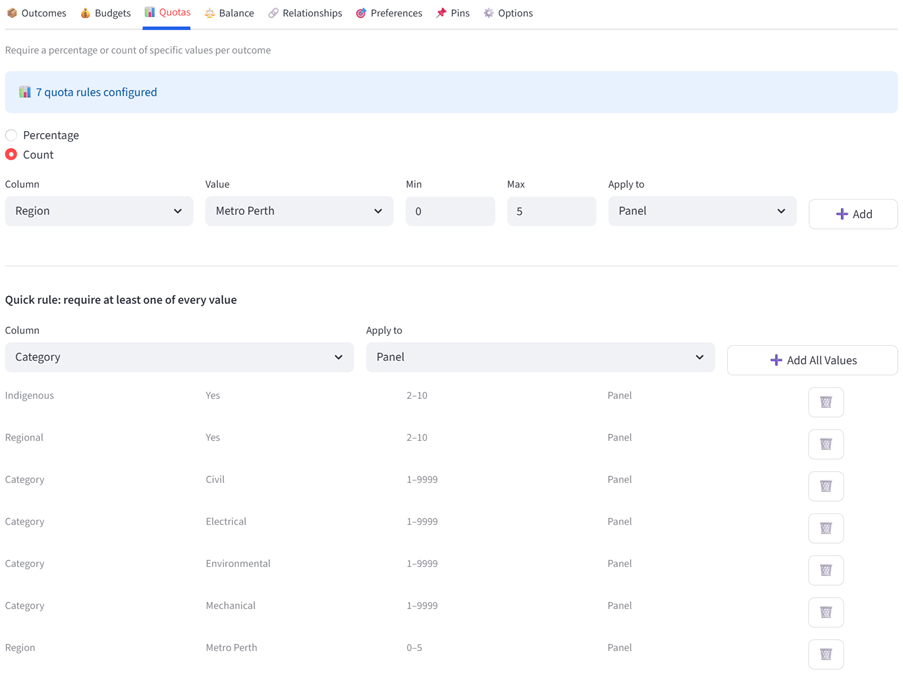
Two groups: Panel (exactly 8) and Unsuccessful (the rest). Maximise capability score in the Panel group. Budget: total contract value max $12M. Quotas: at least 2 Indigenous, at least 1 per category, max 3 from any region, at least 2 regional. Five minutes to set up — the solver handles the combinatorics that would take your team a full afternoon.
Step 3: Get your panel
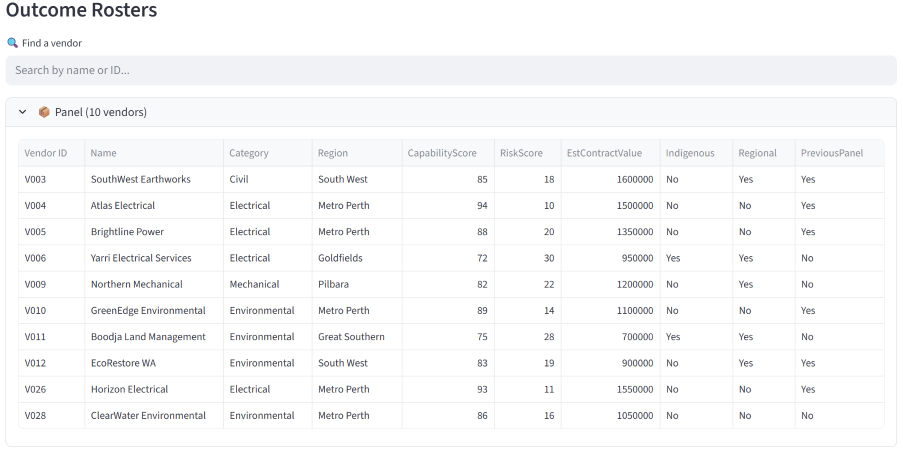
The 10 highest-scoring vendors that satisfy every procurement policy. Average capability score on the panel is 85. All four categories are covered. Two Indigenous suppliers are included. No region is over-represented. Total contract value is $11.9M.
Step 4: Prove it’s compliant
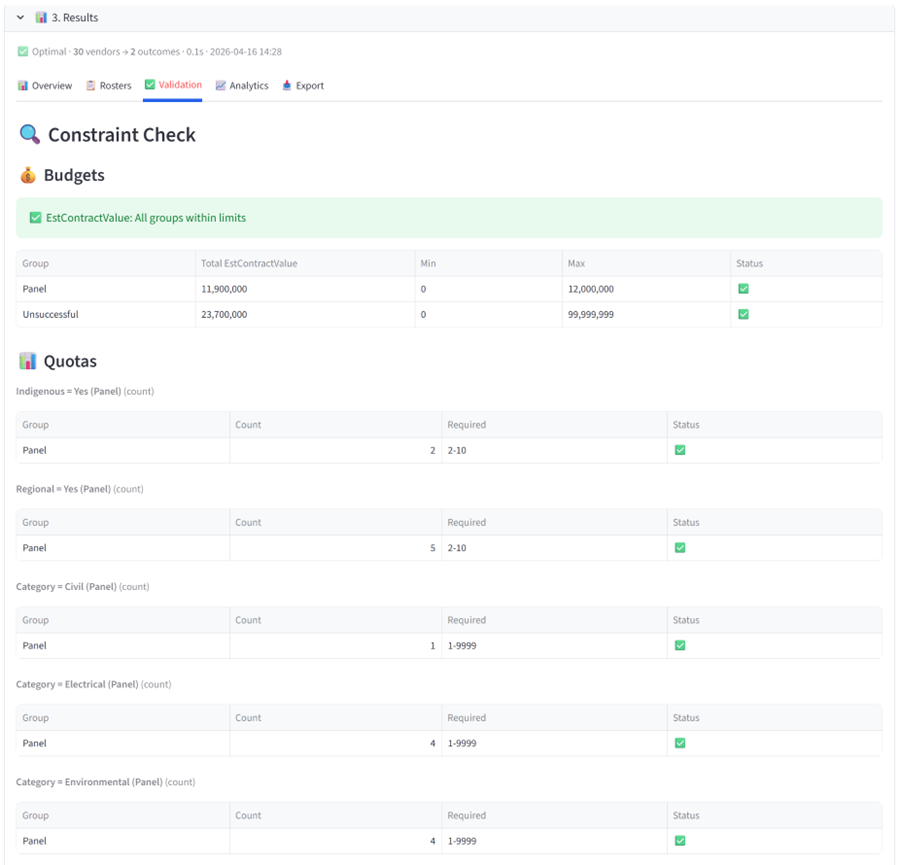
The Validation tab checks every policy requirement and shows pass or fail. The Analytics tab shows score distributions, regional spread, and category coverage. Export the Excel report — it includes a Constraints sheet listing every rule as a complete audit trail. When the probity advisor asks how the panel was formed, the answer is already documented.
The result
Without Balanced Allocate: two days of panel meetings, a shortlist that technically complies but visibly favours incumbent suppliers, and a probity report that takes longer to write than the evaluation itself.
With Balanced Allocate: one procurement officer, fifteen minutes, a mathematically optimal panel with full policy compliance documented. The probity report writes itself — export the constraint audit and attach it.
Not just vendor panels
The same approach works for any procurement or supplier selection with overlapping requirements:
- Standing offer panels: Select 15 pre-qualified suppliers from 80 applicants across service streams, regions, and price bands
- Tender shortlisting: Narrow 30 submissions to 5 for detailed evaluation under cost, risk, and diversity criteria
- Contractor allocation: Distribute 40 approved contractors across 6 project packages balanced by capability, availability, and cost rate
- Supplier diversification: Re-balance an existing panel to meet updated Indigenous procurement targets and regional coverage policies
- Multi-category frameworks: Form panels across parallel categories from a single tender pool, with shared constraints on total contract value
Try it yourself
Download the Balanced Allocate User Guide with this, plus additional full examples, walkthroughs, constraints and dataset formats. The data used in this example is also available for download below.
Your data stays in your browser session. Nothing is stored on our servers.
Ready to stop rearranging sticky notes?
Start Free Trial — 14 days free, no credit card.